
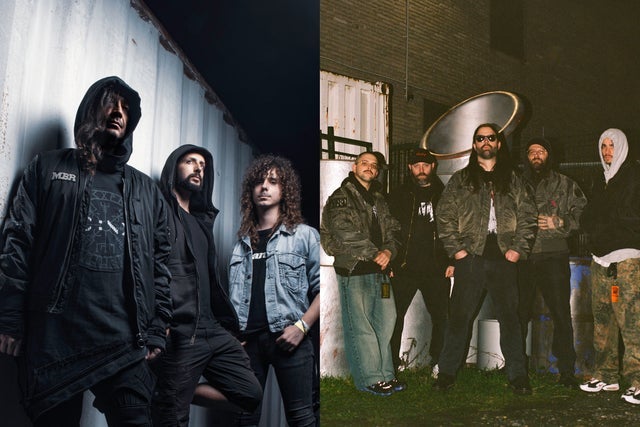
Event research Master Boot Record / Fulci
Master Boot Record / Fulci tickets are on sale right now.
Are Master Boot Record / Fulci tickets likely to be profitable in Amsterdam?
There are 0 presales for this event.

Ai Ticket Reselling Prediction
Sign Up to get artificial intelligence powered ticket reselling predictions!
Using artificial intelligence, concert attendance stats, and completed sales history for ticket prices on secondary market sites like Stubhub, we can predict whether this event is hot for resale. The Ai also considers factors like what music genre, and what market the concert is in.

Shazam is a music app that helps you identify the music playing around you. The more times an artist gets Shazamed, the higher this score will be, which should give you an idea of the popularity of this artist. Scores are ranked on a scale of 1 to 5. Learn more

Google Trends shows how popular a search query is for an artist. The more popular the artist is and the more people that are Googling them, the higher this score will be. Scores are ranked on a scale of 1 to 5. Learn more
1,500
Capacity
Master Boot Record / Fulci at the Melkweg, Amsterdam
Tour Schedule
Master Boot Record / Fulci
6 similar events found
| Event Date | Event | Venue | Capacity | Location | Report |
|---|---|---|---|---|---|
| Nov 13 Fri • 2026 • 6:00pm | Master Boot Record & Fulci | The Academy |

|
Dublin |  |
| Nov 15 Sun • 2026 • 7:00pm | Master Boot Record & Fulci | Brudenell Social Club |
|
Leeds | |
| Nov 18 Wed • 2026 • 7:30pm | Master Boot Record / Fulci | Melkweg |
|
Amsterdam | |
| Nov 22 Sun • 2026 • 8:00pm | MASTER BOOT RECORD // Fulci (co-headline) | Pumpehuset |
|
København V | |
| Nov 25 Wed • 2026 • 7:00pm | Master Boot Record x Fulci | John Dee | Oslo | |
|
| Pro Members see all 6 upcoming events on the tour schedule. | |||||
Watch on YouTube
Listen on iTunes
Wikipedia Bio
A master boot record (MBR) is a type of boot sector in the first block of partitioned computer mass storage devices like fixed disks or removable drives intended for use with IBM PC-compatible systems and beyond. The concept of MBRs was publicly introduced in 1983 with PC DOS 2.0.
The MBR holds the information on how the disc's sectors (A.K.A. "blocks") are divided into partitions, each partition notionally containing a file system. The MBR also contains executable code to function as a loader for the installed operating system—usually by passing control over to the loader's second stage, or in conjunction with each partition's volume boot record (VBR). This MBR code is usually referred to as a boot loader.
The organization of the partition table in the MBR limits the maximum addressable storage space of a partitioned disk to 2 TiB (232 × 512 bytes).[1] Approaches to slightly raise this limit utilizing 32-bit arithmetic or 4096-byte sectors are not officially supported, as they fatally break compatibility with existing boot loaders, most MBR-compliant operating systems and associated system tools, and may cause serious data corruption when used outside of narrowly controlled system environments. Therefore, the MBR-based partitioning scheme has been superseded by the GUID Partition Table (GPT) scheme in almost all new computers. A GPT can coexist with an MBR in order to provide some limited form of backward compatibility for older systems.
MBRs are not present on non-partitioned media such as floppies, superfloppies or other storage devices configured to behave as such, nor are they necessarily present on drives used in non-PC platforms.
Source: Wikipedia