
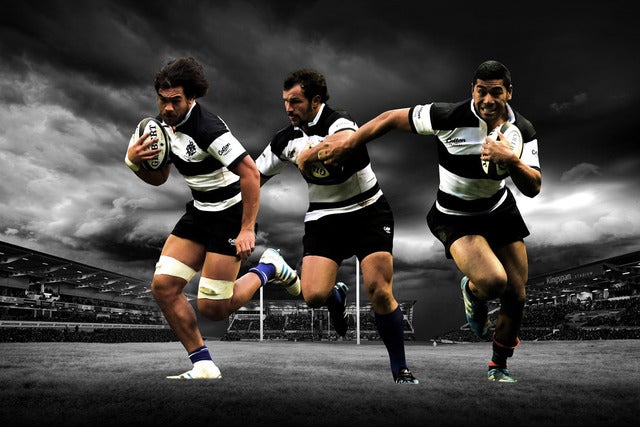
Event research Barbarians vs Springboks
Barbarians vs Springboks tickets are on sale right now.
Are Barbarians vs Springboks tickets likely to be profitable in Gqeberha?
There are 0 presales for this event.

Ai Ticket Reselling Prediction
Sign Up to get artificial intelligence powered ticket reselling predictions!
Using artificial intelligence, concert attendance stats, and completed sales history for ticket prices on secondary market sites like Stubhub, we can predict whether this event is hot for resale. The Ai also considers factors like what music genre, and what market the concert is in.

Shazam is a music app that helps you identify the music playing around you. The more times an artist gets Shazamed, the higher this score will be, which should give you an idea of the popularity of this artist. Scores are ranked on a scale of 1 to 5. Learn more

Google Trends shows how popular a search query is for an artist. The more popular the artist is and the more people that are Googling them, the higher this score will be. Scores are ranked on a scale of 1 to 5. Learn more
Barbarians vs Springboks at the Nelson Mandela Bay Stadium, Gqeberha
Tour Schedule
Barbarians vs Springboks
6 similar events found
| Event Date | Event | Venue | Capacity | Location | Report |
|---|---|---|---|---|---|
| Jun 26 Fri • 2026 • 5:00pm | Barbarians vs Springboks | Nelson Mandela Bay Stadium | Gqeberha |  |
|
| Jun 27 Sat • 2026 | Barbarians v Wales & Barbarians Women v Wales Women | Allianz Stadium, Twickenham |

|
London | |
| Aug 29 Sat • 2026 • 5:00pm | Springboks vs All Blacks | DHL Stadium |
|
Cape Town | |
| Sep 12 Sat • 2026 | New Zealand All Blacks vs. Springboks | M&T Bank Stadium |
|
Baltimore, MD | |
| Sep 27 Sun • 2026 | The Flight Centre Series - Wallabies v Springboks | Optus Stadium |
|
Burswood, WA | |
| Pro Members see all 6 upcoming events on the tour schedule. | |||||
Watch on YouTube
Listen on iTunes
Wikipedia Bio

A barbarian is, etymologically, a foreigner, specifically someone whose language and customs differ from those of the speaker. In ancient Greece, the term designated non-Greeks, while in the Roman world it referred more generally to peoples living outside the cultural and political sphere of the empire. In modern English, the word has developed a pejorative sense, commonly meaning a "rude, wild, uncivilized person".[1]
The term originates from the Ancient Greek: βάρβαρος (barbaros; pl. βάρβαροι barbaroi). In ancient Greece, the Greeks used the term not only for those who did not speak Greek and follow classical Greek customs, but also for Greek populations on the fringe of the Greek world with peculiar dialects.[2] In ancient Rome, the Romans adapted and applied the term to tribal non-Romans such as the Huns, Germans, Celts, Iberians, Helvetii, Thracians, Illyrians, and Sarmatians. In the early modern period and sometimes later, the Byzantine Greeks used it for the Turks in a clearly pejorative manner.[3][4]
The Greek word was borrowed into Arabic as well, under the form بربر (barbar), and used as an exonym by the Arab invaders to refer to the indigenous peoples of North Africa, known in English as Amazigh or Berbers, with the latter thereby being a cognate of the word "barbarian".
- ^ "barbarian, n. & adj.", Oxford English Dictionary (3 ed.), Oxford University Press, 2023, doi:10.1093/OED/1046593542
- ^ Crespo, Emilio; Giannakis, Georgios; Filos, Panagiotis (2017). Studies in Ancient Greek Dialects: From Central Greece to the Black Sea. De Gruyter. p. 218. ISBN 978-3-11-053213-5.
- ^ Εκδοτική Αθηνών, ο Ελληνισμός υπό ξένη κυριαρχία: Τουρκοκρατία, Λατινοκρατία, 1980, p. 34 (in Greek).
- ^ Justin Marozzi, The Way of Herodotus: Travels with the Man who Invented History, 2010, pp. 311–315.
Source: Wikipedia