
Event research THE HARMONY OF ROCK Ultimate Three Dog Night, Eagles and 70's Tribute
THE HARMONY OF ROCK Ultimate Three Dog Night, Eagles and 70's Tribute tickets are on sale right now.
Are THE HARMONY OF ROCK Ultimate Three Dog Night, Eagles and 70's Tribute tickets likely to be profitable in San Leandro, CA?
There are 0 presales for this event.
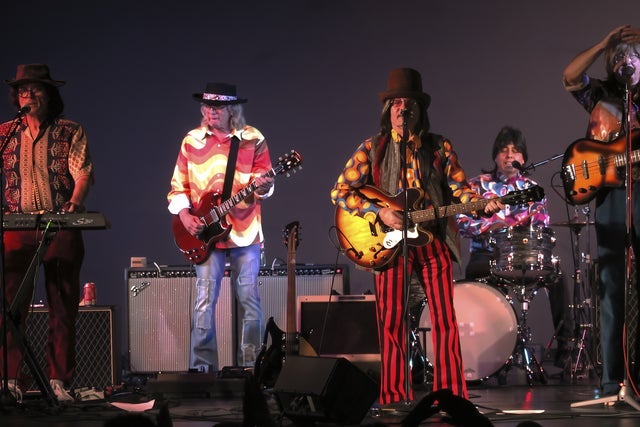
THE HARMONY OF ROCK Ultimate Three Dog Night, Eagles and 70's Tribute
Historic BAL Theatre
San Leandro, CA
May 22 Fri • 2026 • 8:00pm
Rock and Pop | More Concerts | Event | Rock | Classical | Musical | Theatre
Ai Ticket Reselling Prediction
Sign Up to get artificial intelligence powered ticket reselling predictions!
Using artificial intelligence, concert attendance stats, and completed sales history for ticket prices on secondary market sites like Stubhub, we can predict whether this event is hot for resale. The Ai also considers factors like what music genre, and what market the concert is in.


Shazam is a music app that helps you identify the music playing around you. The more times an artist gets Shazamed, the higher this score will be, which should give you an idea of the popularity of this artist. Scores are ranked on a scale of 1 to 5. Learn more

Google Trends shows how popular a search query is for an artist. The more popular the artist is and the more people that are Googling them, the higher this score will be. Scores are ranked on a scale of 1 to 5. Learn more
805
Capacity
THE HARMONY OF ROCK Ultimate Three Dog Night, Eagles and 70's Tribute at the Historic BAL Theatre, San Leandro, CA
Tour Schedule
THE HARMONY OF ROCK Ultimate Three Dog Night, Eagles and 70's Tribute
33 similar events found
| Event Date | Event | Venue | Capacity | Location | Report |
|---|---|---|---|---|---|
| Apr 30 Thu • 2026 • 7:30pm | Three Dog Night | Avalon Theatre |
|
Grand Junction, CO |  |
| May 3 Sun • 2026 • 7:00pm | Three Dog Night | Ford Wyoming Center |
|
Casper, WY | |
| May 21 Thu • 2026 • 7:00pm | Three Dog Night + Ambrosia with John Ford Coley | DECC Symphony Hall |
|
Duluth, MN | |
| May 22 Fri • 2026 • 7:00pm | Three Dog Night + Ambrosia W/ John Ford Coley | Mayo Civic Center Auditorium |
|
Rochester, MN | |
| May 22 Fri • 2026 • 8:00pm | THE HARMONY OF ROCK Ultimate Three Dog Night, Eagles and 70's Tribute | Historic BAL Theatre |
|
San Leandro, CA | |
| Pro Members see all 33 upcoming events on the tour schedule. | |||||
Watch on YouTube
Listen on iTunes
Wikipedia Bio

In music, harmony is the concept of combining different sounds in order to create new, distinct musical ideas.[1] Theories of harmony seek to describe or explain the effects created by distinct pitches or tones coinciding with one another; harmonic objects such as chords, textures and tonalities are identified, defined, and categorized in the development of these theories. Harmony is broadly understood to involve both a "vertical" dimension (frequency-space) and a "horizontal" dimension (time-space), and often overlaps with related musical concepts such as melody, timbre, and form.[2]
A particular emphasis on harmony is one of the core concepts underlying the theory and practice of Western music.[3] The study of harmony involves the juxtaposition of individual pitches to create chords, and in turn the juxtaposition of chords to create larger chord progressions. The principles of connection that govern these structures have been the subject of centuries worth of theoretical work and vernacular practice alike.[4]
Drawing both from music theoretical traditions and the field of psychoacoustics, its perception in large part consists of recognizing and processing consonance, a concept whose precise definition has varied throughout history, but is often associated with simple mathematical ratios between coincident pitch frequencies. In the physiological approach, consonance is viewed as a continuous variable measuring the human brain's ability to 'decode' aural sensory input. Culturally, consonant pitch relationships are often described as sounding more pleasant, euphonious, and beautiful than dissonant pitch relationships, which can be conversely characterized as unpleasant, discordant, or rough.[5]
In popular and jazz harmony, chords are named by their root plus various terms and characters indicating their qualities. In many types of music, notably baroque, romantic, modern, and jazz, chords are often augmented with "tensions". A tension is an additional chord member that creates a relatively dissonant interval in relation to the bass. The notion of counterpoint seeks to understand and describe the relationships between melodic lines, often in the context of a polyphonic texture of several simultaneous but independent voices. Therefore, it is sometimes seen as a type of harmonic understanding, and sometimes distinguished from harmony.[6]
Typically, in the classical common practice period, a dissonant chord (chord with tension) "resolves" to a consonant chord. Harmonization usually sounds pleasant when there is a balance between consonance and dissonance. This occurs when there is a balance between "tense" and "relaxed" moments. Dissonance is an important part of harmony when it can be resolved and contribute to the composition of music as a whole. A misplayed note or any sound that is judged to detract from the whole composition can be described as disharmonious rather than dissonant.[1]
- ^ a b Lomas, J. Derek; Xue, Haian (1 March 2022). "Harmony in Design: A Synthesis of Literature from Classical Philosophy, the Sciences, Economics, and Design". She Ji: The Journal of Design, Economics, and Innovation. 8 (1): 5–64. doi:10.1016/j.sheji.2022.01.001. S2CID 247870504.
- ^ Chan, Paul Yaozhu; Dong, Minghui; Li, Haizhou (29 September 2019). "The Science of Harmony: A Psychophysical Basis for Perceptual Tensions and Resolutions in Music". Research. 2019: 1–22. doi:10.34133/2019/2369041. PMC 7006947. PMID 32043080.
- ^ Malm, William P. (1996). Music Cultures of the Pacific, the Near East, and Asia, p. 15. ISBN 0-13-182387-6. Third edition. "Homophonic texture...is more common in Western music, where tunes are often built on chords (harmonies) that move in progressions. Indeed this harmonic orientation is one of the major differences between Western and much non-Western music."
- ^ Dahlhaus, Carl (2001). "Harmony". In Sadie, Stanley; Tyrrell, John (eds.). The New Grove Dictionary of Music and Musicians (2nd ed.). London: Macmillan Publishers. ISBN 978-1-56159-239-5.
- ^ "Musical building blocks". ISM Trust. Retrieved 2 October 2021.
- ^ Sachs, Klaus-Jürgen; Dahlhaus, Carl (2001). Counterpoint. Oxford University Press. doi:10.1093/gmo/9781561592630.article.06690. ISBN 9781561592630.
Source: Wikipedia