
Event research London Symphonic Rock Orchestra
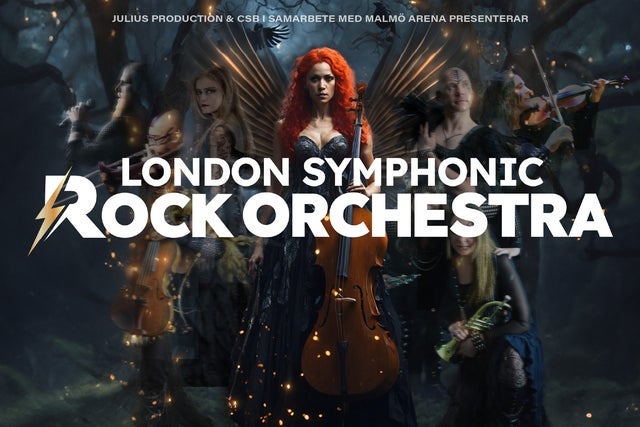
London Symphonic Rock Orchestra tickets are on sale right now.
Are London Symphonic Rock Orchestra tickets likely to be profitable in Malmö?
There are 0 presales for this event.

Ai Ticket Reselling Prediction
Sign Up to get artificial intelligence powered ticket reselling predictions!
Using artificial intelligence, concert attendance stats, and completed sales history for ticket prices on secondary market sites like Stubhub, we can predict whether this event is hot for resale. The Ai also considers factors like what music genre, and what market the concert is in.

Shazam is a music app that helps you identify the music playing around you. The more times an artist gets Shazamed, the higher this score will be, which should give you an idea of the popularity of this artist. Scores are ranked on a scale of 1 to 5. Learn more

Google Trends shows how popular a search query is for an artist. The more popular the artist is and the more people that are Googling them, the higher this score will be. Scores are ranked on a scale of 1 to 5. Learn more
15,500
Capacity
London Symphonic Rock Orchestra at the Malmö Arena, Malmö
Tour Schedule
London Symphonic Rock Orchestra
10 similar events found
| Event Date | Event | Venue | Capacity | Location | Report |
|---|---|---|---|---|---|
| Jun 9 Tue • 2026 • 7:30pm | Jimmy Carr - Laughs Funny | Malmö Arena |

|
Malmö |  |
| Jun 30 Tue • 2026 • 7:30pm | ZZ TOP | Malmö Arena |
|
Malmö | |
| Oct 4 Sun • 2026 • 8:00pm | London Symphonic Rock Orchestra | Operaen, Holmen |
|
København K | |
| Oct 9 Fri • 2026 • 7:00pm | London Symphonic Rock Orchestra | Malmö Arena |
|
Malmö | |
| Oct 12 Mon • 2026 • 7:00pm | London Symphonic Rock Orchestra | Göta Lejon |
|
Stockholm | |
| Pro Members see all 10 upcoming events on the tour schedule. | |||||
Watch on YouTube
Listen on iTunes
Wikipedia Bio
| London Symphony Orchestra | |
|---|---|
| Orchestra | |
 The London Symphony Orchestra at the Barbican | |
| Founded | 1904 |
| Concert hall | Barbican Centre |
| Principal conductor | Sir Antonio Pappano |
| Website | www |
The London Symphony Orchestra (LSO) is a British ensemble based in London. Founded in 1904, the LSO is the oldest of London's symphony orchestras. It was created by a group of players who left Henry Wood's Queen's Hall Orchestra because of a new rule requiring players to give the orchestra their exclusive services. The LSO itself later introduced a similar rule for its members. From the outset the LSO was organised on co-operative lines, with all players sharing the profits at the end of each season. This practice continued for the orchestra's first four decades.
The LSO underwent periods of eclipse in the 1930s and 1950s when it was regarded as inferior in quality to new London orchestras, to which it lost players and bookings: the BBC Symphony Orchestra and the London Philharmonic Orchestra in the 1930s and the Philharmonia and Royal Philharmonic after the Second World War. The profit-sharing principle was abandoned in the post-war era as a condition of receiving public subsidy for the first time. In the 1950s the orchestra debated whether to concentrate on film work at the expense of symphony concerts; many senior players left when the majority of players rejected the idea.
By the 1960s the LSO had recovered its leading position, which it has retained subsequently. In 1966, to perform alongside it in choral works, the orchestra established the LSO Chorus, originally a mix of professional and amateur singers, later a wholly amateur ensemble. As a self-governing body, the orchestra selects the conductors with whom it works. At some stages in its history it has dispensed with a principal conductor and worked only with guests. Among conductors with whom it is most associated are, in its early days, Hans Richter, Sir Edward Elgar, and Sir Thomas Beecham, and in more recent decades Pierre Monteux, André Previn, Claudio Abbado, Sir Colin Davis, Valery Gergiev and Sir Simon Rattle. Its current chief conductor is Sir Antonio Pappano.
Since 1982 the LSO has been based in the Barbican Centre in the City of London. Among its programmes there have been large-scale festivals celebrating composers as diverse as Berlioz, Mahler and Leonard Bernstein. The LSO claims to be the world's most recorded orchestra; it has made gramophone recordings since 1912 and has played on more than 200 soundtrack recordings for the cinema, of which the best known include the Star Wars series.
Source: Wikipedia