
Event research Freestyle Feast 2026
Freestyle Feast 2026 tickets are on sale right now.
Are Freestyle Feast 2026 tickets likely to be profitable in Farmingville, NY?
There are 0 presales for this event.
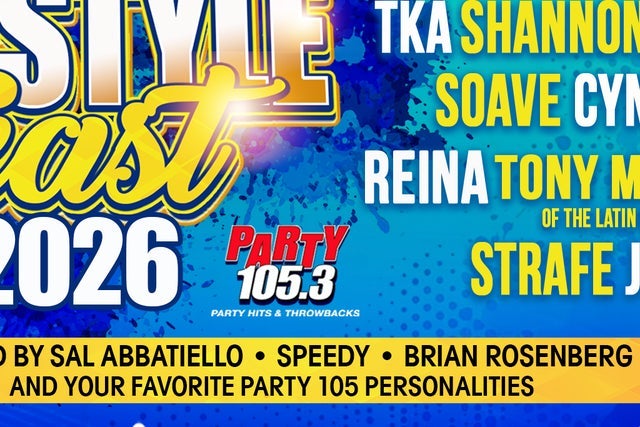
Freestyle Feast 2026
Catholic Health Amphitheater at Bald Hill
Farmingville, NY
Jul 25 Sat • 2026 • 7:00pm
Rock and Pop | Rap and Hip-Hop | R&B/Urban Soul | Dance/Electronic | Latin | More Concerts | More Miscellaneous | R&B | Pop | Festivals | Rock
Ai Ticket Reselling Prediction
Sign Up to get artificial intelligence powered ticket reselling predictions!
Using artificial intelligence, concert attendance stats, and completed sales history for ticket prices on secondary market sites like Stubhub, we can predict whether this event is hot for resale. The Ai also considers factors like what music genre, and what market the concert is in.


Shazam is a music app that helps you identify the music playing around you. The more times an artist gets Shazamed, the higher this score will be, which should give you an idea of the popularity of this artist. Scores are ranked on a scale of 1 to 5. Learn more

Google Trends shows how popular a search query is for an artist. The more popular the artist is and the more people that are Googling them, the higher this score will be. Scores are ranked on a scale of 1 to 5. Learn more

7,005
Capacity
Freestyle Feast 2026 at the Catholic Health Amphitheater at Bald Hill, Farmingville, NY
Tour Schedule
Freestyle Feast 2026
13 similar events found
| Event Date | Event | Venue | Capacity | Location | Report |
|---|---|---|---|---|---|
| May 16 Sat • 2026 • 8:00pm | 10th Annual Freestyle Jersey Jam | The Wellmont Theater |
|
Montclair, NJ |  |
| Jun 20 Sat • 2026 | Pepsi MAX presents Parklife 2026 Weekend | Heaton Park | Manchester | |
|
| Jun 27 Sat • 2026 • 6:00pm | Freestyle Festival Feat Lisa Lisa & Stevie B | Toyota Arena |
|
Ontario, CA | |
| Jul 11 Sat • 2026 • 8:00pm | 80s Brick City Freestyle | New Jersey Performing Arts Center |
|
Newark, NJ | |
| Jul 25 Sat • 2026 • 7:00pm | Freestyle Feast 2026 | Catholic Health Amphitheater at Bald Hill |
|
Farmingville, NY | |
| Pro Members see all 13 upcoming events on the tour schedule. | |||||
Watch on YouTube
Listen on iTunes
Wikipedia Bio
 | This article needs additional citations for verification. Please help improve this article by adding citations to reliable sources. Unsourced material may be challenged and removed. Find sources: "Claude Shannon" – news · newspapers · books · scholar · JSTOR (April 2026) (Learn how and when to remove this message) |
Claude Shannon | |
|---|---|
.jpg) Shannon c. 1950s | |
| Born | Claude Elwood Shannon (1916-04-30)April 30, 1916 Petoskey, Michigan, U.S. |
| Died | February 24, 2001(2001-02-24) (aged 84) Medford, Massachusetts, U.S. |
| Education | University of Michigan (BS, BSE) Massachusetts Institute of Technology (MS, PhD) |
| Known for | |
| Spouses | |
| Awards |
|
| Scientific career | |
| Fields | Mathematics, computer science, electronic engineering, artificial intelligence |
| Institutions |
|
| Theses | |
| Frank Lauren Hitchcock | |
Doctoral students | |
Other notable students | Chung Laung Liu |
Claude Elwood Shannon (April 30, 1916 – February 24, 2001) was an American polymath who was a mathematician, electrical engineer, computer scientist, cryptographer, and inventor known as the "father of information theory", and the man who laid the foundations of the Information Age.[1][2][3]
Shannon was the first to describe the use of Boolean algebra—essential to all digital electronic circuits—and helped found the field of artificial intelligence.[4][5][6] The roboticist Rodney Brooks declared Shannon the 20th century engineer who contributed the most to 21st century technologies,[7] and the mathematician Solomon W. Golomb described his intellectual achievement as "one of the greatest of the twentieth century".[8]
At the University of Michigan, Shannon dual-degreed, graduating with a Bachelor of Science in electrical engineering and another in mathematics, both in 1936. As a 21-year-old master's degree student in electrical engineering at MIT, his 1937 thesis, "A Symbolic Analysis of Relay and Switching Circuits", demonstrated that electrical applications of Boolean algebra could construct any logical numerical relationship,[9] thereby establishing the theory behind digital computing and digital circuits.[10] Called by some the most important master's thesis of all time,[9] it is the "birth certificate of the digital revolution",[11] and started him in a lifetime of work that led him to win a Kyoto Prize in 1985.[12] He graduated from MIT in 1940 with a PhD in mathematics;[13] his thesis focusing on genetics contained important results, while initially going unpublished.[14]
Shannon contributed to the field of cryptanalysis for national defense of the United States during World War II, including his fundamental work on codebreaking and secure telecommunications, writing a paper which is considered one of the foundational pieces of modern cryptography,[15] with his work described as "a turning point, and marked the closure of classical cryptography and the beginning of modern cryptography". His work was foundational for symmetric-key cryptography, including the work of Horst Feistel, the Data Encryption Standard (DES), and the Advanced Encryption Standard (AES).[16] As a result, Shannon has been called the "founding father of modern cryptography".[17]
His 1948 paper "A Mathematical Theory of Communication" laid the foundations for the field of information theory,[13][18] referred to as a "blueprint for the digital era" by electrical engineer Robert G. Gallager[19] and "the Magna Carta of the Information Age" by Scientific American.[20][21] Golomb compared Shannon's influence on the digital age to that which "the inventor of the alphabet has had on literature".[18] Shannon is also regarded as the most important post-1948 contributor to the theory. Advancements across multiple scientific disciplines utilized Shannon's theory—including the invention of the compact disc, the development of the Internet, the commercialization of mobile telephony, and the understanding of black holes.[22][23] He formally introduced the term "bit",[2][24] and was a co-inventor of both pulse-code modulation and the first wearable computer. He also invented the signal-flow graph.
Shannon joined the Central Intelligence Agency's Special Cryptologic Advisory Group in 1951. From 1956 to 1978, he was a professor at MIT. He also made numerous contributions to the field of artificial intelligence,[4] including co-organizing the 1956 Dartmouth workshop, considered to be the discipline's founding event,[25][26] and papers on the programming of chess computers.[27][28] His Theseus machine was the first electrical device to learn by trial and error, being one of the first examples of artificial intelligence.[7][29]
- ^ Atmar, Wirt (2001). "A Profoundly Repeated Pattern". Bulletin of the Ecological Society of America. 82 (3): 208–211. ISSN 0012-9623. JSTOR 20168572.
- ^ a b Tse, David (December 22, 2020). "How Claude Shannon Invented the Future". Quanta. Retrieved September 28, 2023.
- ^ Roberts, Siobhan (April 30, 2016). "The Forgotten Father of the Information Age". The New Yorker. ISSN 0028-792X. Retrieved September 28, 2023.
- ^ a b Slater, Robert (1989). Portraits in Silicon. Cambridge, Mass.: MIT Press. pp. 37–38. ISBN 978-0-262-69131-4.
- ^ James, Ioan (2009). "Claude Elwood Shannon, 30 April 1916 – 24 February 2001". Biographical Memoirs of Fellows of the Royal Society. 55 (55): 257–265. doi:10.1098/rsbm.2009.0015.
- ^ Horgan, John (April 27, 2016). "Claude Shannon: Tinkerer, Prankster, and Father of Information Theory". IEEE Spectrum. Retrieved September 28, 2023.
- ^ a b Brooks, Rodney (January 25, 2022). "How Claude Shannon Helped Kick-start Machine Learning". IEEE Spectrum. Retrieved October 31, 2023.
- ^ Golomb, Solomon W. (January 2002). "Claude Elwood Shannon (1916–2001)" (PDF). Notices of the American Mathematical Society. 49 (1).
- ^ a b Poundstone, William (2005). Fortune's Formula: The Untold Story of the Scientific Betting System That Beat the Casinos and Wall Street. Hill & Wang. p. 20. ISBN 978-0-8090-4599-0.
- ^ Chow, Rony (June 5, 2021). "Claude Shannon: The Father of Information Theory". History of Data Science. Retrieved January 11, 2024.
- ^ Vignes, Alain (2023). Silicon, From Sand to Chips, 1: Microelectronic Components. Hoboken: ISTE / John Wiley and Sons. p. xv. ISBN 978-1-78630-921-1.
- ^ Rioul, Olivier (2021), Duplantier, Bertrand; Rivasseau, Vincent (eds.), "This is IT: A Primer on Shannon's Entropy and Information", Information Theory: Poincaré Seminar 2018, Progress in Mathematical Physics, vol. 78, Cham: Springer, pp. 49–86, doi:10.1007/978-3-030-81480-9_2, ISBN 978-3-030-81480-9
{{citation}}: CS1 maint: work parameter with ISBN (link) - ^ a b "Claude E. Shannon". IEEE Information Theory Society. Retrieved October 31, 2023.
- ^ Gallager, Robert G. (2001). "Claude E. Shannon: A Retrospective on His Life, Work, and Impact" (PDF). IEEE Transactions on Information Theory. 47 (7): 2681–2695. Bibcode:2001ITIT...47.2681G. doi:10.1109/18.959253.
- ^ Shimeall, Timothy J.; Spring, Jonathan M. (2013). Introduction to Information Security: A Strategic-Based Approach. Syngress. p. 167. ISBN 978-1597499699.
- ^ Koç, Çetin Kaya; Özdemir, Funda (2023). "Development of Cryptography since Shannon" (PDF). Handbook of Formal Analysis and Verification in Cryptography: 1–56. doi:10.1201/9781003090052-1. ISBN 978-1-003-09005-2.
- ^ Bruen, Aiden A.; Forcinito, Mario (2005). Cryptography, Information Theory, and Error-Correction: A Handbook for the 21st Century. Hoboken: Wiley-Interscience. p. 3. ISBN 978-0-471-65317-2. OCLC 56191935.
- ^ a b Poundstone 2005, pp. 15–16
- ^ "Claude Shannon: Reluctant Father of the Digital Age". MIT Technology Review. July 1, 2001. Retrieved June 26, 2024.
- ^ Goodman, Jimmy Soni and Rob (2017-07-30). "Claude Shannon: The Juggling Poet Who Gave Us the Information Age". Daily Beast. Retrieved 2023-10-31.
- ^ Goodman, Rob; Soni, Jimmy (2018). "Genius in Training". Alumni Association of the University of Michigan. Retrieved October 31, 2023.
- ^ Chang, Mark (2014). Principles of Scientific Methods. Boca Raton: CRC Press. p. 217. ISBN 978-1-4822-3809-9.
- ^ Jha, Alok (April 30, 2016). "Without Claude Shannon's information theory there would have been no internet". The Guardian. Retrieved July 21, 2024.
- ^ Keats, Jonathon (November 11, 2010). Virtual Words: Language from the Edge of Science and Technology. Oxford University Press. p. 36. doi:10.1093/oso/9780195398540.001.0001. ISBN 978-0-19-539854-0.
- ^ McCarthy, John; Minsky, Marvin L.; Rochester, Nathaniel; Shannon, Claude E. (December 15, 2006). "A Proposal for the Dartmouth Summer Research Project on Artificial Intelligence, August 31, 1955". AI Magazine. Vol. 27, no. 4. p. 12. doi:10.1609/aimag.v27i4.1904. ISSN 2371-9621.
- ^ Solomonoff, Grace (May 6, 2023). "The Meeting of the Minds That Launched AI". IEEE Spectrum. Retrieved June 19, 2024.
- ^ Apter, Michael J. (2018). The Computer Simulation of Behaviour. Routledge Library Editions: Artificial intelligence. Routledge. p. 123. ISBN 978-0-8153-8566-0.
- ^ Lowood, Henry; Guins, Raiford, eds. (June 3, 2016). Debugging Game History: A Critical Lexicon. The MIT Press. pp. 31–32. doi:10.7551/mitpress/10087.001.0001. ISBN 978-0-262-33194-4.
- ^ Cite error: The named reference
MITwas invoked but never defined (see the help page).
Source: Wikipedia