
Event research JALC Jazz Lounge: Vanisha Gould
JALC Jazz Lounge: Vanisha Gould tickets are on sale right now.
Are JALC Jazz Lounge: Vanisha Gould tickets likely to be profitable in Brookville, NY?
There are 0 presales for this event.
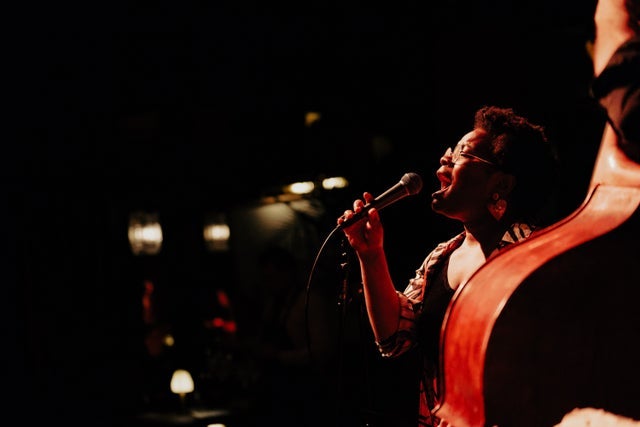
JALC Jazz Lounge: Vanisha Gould
Tilles Center - Herbert and Dolores Goldsmith Atrium
Brookville, NY
Apr 2 Thu • 2026 • 7:30pm
Rock and Pop | Rap and Hip-Hop | R&B | Jazz and Blues
Ai Ticket Reselling Prediction
Sign Up to get artificial intelligence powered ticket reselling predictions!
Using artificial intelligence, concert attendance stats, and completed sales history for ticket prices on secondary market sites like Stubhub, we can predict whether this event is hot for resale. The Ai also considers factors like what music genre, and what market the concert is in.


Shazam is a music app that helps you identify the music playing around you. The more times an artist gets Shazamed, the higher this score will be, which should give you an idea of the popularity of this artist. Scores are ranked on a scale of 1 to 5. Learn more

Google Trends shows how popular a search query is for an artist. The more popular the artist is and the more people that are Googling them, the higher this score will be. Scores are ranked on a scale of 1 to 5. Learn more

720
Capacity
JALC Jazz Lounge: Vanisha Gould at the Tilles Center - Herbert and Dolores Goldsmith Atrium, Brookville, NY
Tour Schedule
JALC Jazz Lounge: Vanisha Gould
4 similar events found
| Event Date | Event | Venue | Capacity | Location | Report |
|---|---|---|---|---|---|
| May 3 Sun • 2026 • 6:00pm | May Day Jazz Jam | Humphreys Backstage Live |
|
San Diego, CA |  |
| May 15 Fri • 2026 • 7:30pm | Gabrielle Cavassa 'DIAVOLA' Album Release | New Orleans Jazz Market |
|
New Orleans, LA | |
| Jun 28 Sun • 2026 • 4:00pm | Calvin Harris | Malahide Castle |
|
Co. Dublin, D | |
| Jul 22 Wed • 2026 • 6:00pm | Shez Raja ft Guthrie Govan Wed 22 July 26 Performing Live Jam House Bham | The Jam House Birmingham |
|
Birmingham | |
Watch on YouTube
Listen on iTunes
Wikipedia Bio
| Jazz | |
|---|---|
| Etymology | See: Jazz (word) |
| Stylistic origins | |
| Cultural origins | Late 19th century, New Orleans, U.S. |
| Typical instruments | |
| Derivative forms | |
| Subgenres | |
Subgenres (complete list) | |
| Fusion genres | |
| Regional scenes | |
Regional scenes | |
| Other topics | |
 2026 in jazz 2026 in jazz | |
Jazz is a music genre that originated in the African-American communities of New Orleans, Louisiana, in the late 19th and early 20th centuries. Its roots are in blues, ragtime, European harmony, African rhythmic rituals, spirituals, hymns, marches, vaudeville song, and dance music. Since the 1920s Jazz Age, it has been recognized as a major form of musical expression in traditional and popular music. Jazz is characterized by swing and blue notes, complex chords, call and response vocals, polyrhythms and improvisation.
As jazz spread around the world, it drew on national, regional, and local musical cultures, which gave rise to different styles. New Orleans jazz began in the early 1910s, combining earlier brass band marches, French quadrilles, biguine, ragtime and blues with collective polyphonic improvisation. However, jazz did not begin as a single musical tradition in New Orleans or elsewhere.[1] In the 1930s, arranged dance-oriented swing big bands, Kansas City jazz (a hard-swinging, bluesy, improvisational style), and gypsy jazz (a style that emphasized musette waltzes) were the prominent styles. Bebop emerged in the 1940s, shifting jazz from danceable popular music toward a more challenging "musician's music" which was played at faster tempos and used more chord-based improvisation. Cool jazz developed near the end of the 1940s, introducing calmer, smoother sounds and long, linear melodic lines.[2]
The mid-1950s saw the emergence of hard bop, which introduced influences from rhythm and blues, gospel, and blues to small groups and particularly to saxophone and piano. Modal jazz developed in the late 1950s, using the mode, or musical scale, as the basis of musical structure and improvisation, as did free jazz, which explored playing without regular meter, beat and formal structures. Jazz fusion appeared in the late 1960s and early 1970s, combining jazz improvisation with rock music's rhythms, electric instruments, and highly amplified stage sound. In the early 1980s, a commercial form of jazz fusion called smooth jazz became successful, garnering significant radio airplay. Other styles and genres abound in the 21st century, such as Latin and Afro-Cuban jazz.
- ^ Hennessey, Thomas (1973). From Jazz to Swing: Black Jazz Musicians and Their Music, 1917–1935 (Ph.D. dissertation). Northwestern University. p. 470.
- ^ Ventura, David (May 22, 2018). WJEC & EDUQAS GCSE Music Revision Guide. Rhinegold Education. ISBN 978-1-7875-9098-4.
Source: Wikipedia